Distilled Water for CPAP, and the One Tub That Takes Tap
- Use distilled water in your CPAP humidifier. The Philips DreamStation 2 manual and ResMed’s standard AirSense 11 tub both say distilled water only.
- One tub is different. ResMed’s HumidAir 11 Cleanable tub, the one with the gray grip, is made for drinking quality tap water.
- Tap water leaves minerals behind. A full 380 mL tub of moderately hard water carries about 46 mg of hardness, which adds up to about 17 grams a year if it all boils off.
- Boiled water is not distilled water. Boiling kills germs, but the minerals stay in the pot.
- Empty the tub every morning and refill it at night. Both manuals say so, and old water is where germs grow.
Contents
This page is general information. It is not medical advice. Follow the manual that came with your own machine and ask your equipment supplier or doctor if you are unsure. If you get a fever, cough or trouble breathing after using your CPAP, call your doctor. For severe trouble breathing, call 911.
Most people think every CPAP needs distilled water. That is true for most tubs, but not all of them. ResMed’s AirSense 11 manual lists two humidifier tubs, and only one of them is distilled water only. The other takes drinking quality water from the tap.1
We wrote this for anyone standing at the sink at bedtime with an empty tub and no jug of distilled water. You’ll find what the manuals say, what each kind of bottled water really is and what to do tonight.
What the Two Big Makers Tell You
Start with the manual for your own machine. The table sums up what the current ResMed and Philips manuals say about the water and the daily care.
| Machine and tub | Water the manual names | Every day | Every week |
|---|---|---|---|
| ResMed AirSense 11, HumidAir 11 Standard tub (white grip)1 | Distilled water only | Empty, wipe dry, refill | Wash in warm water with mild dish soap, or soak in 1 part vinegar to 9 parts water |
| ResMed AirSense 11, HumidAir 11 Cleanable tub (gray grip)1 | Drinking quality water | Empty, wipe dry, refill | Same as the Standard tub |
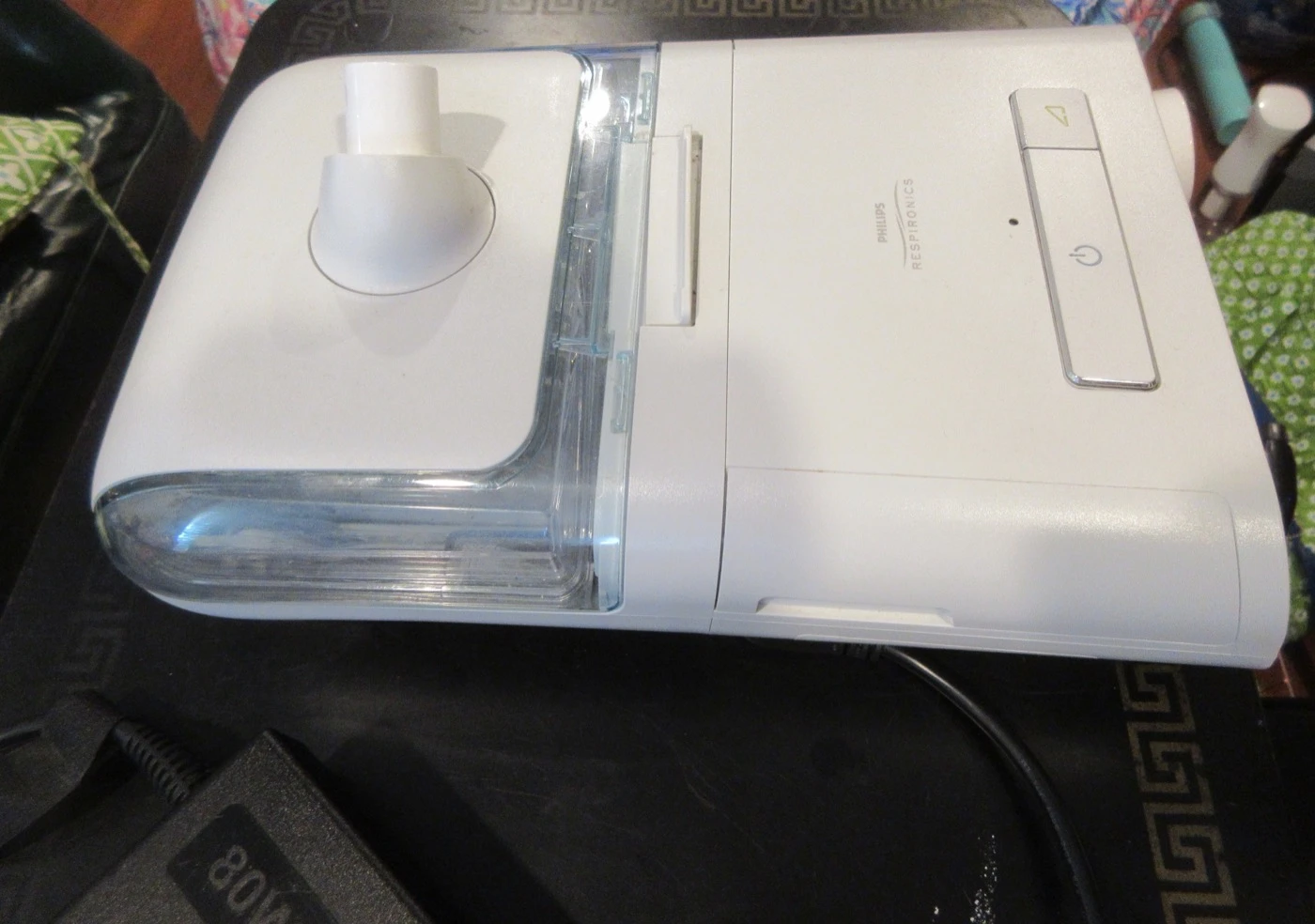
| Philips DreamStation 22 | Room temperature distilled water only, with nothing added | Empty and clean the tank | Follow the cleaning steps in the manual |
ResMed says its tub holds up to 380 mL and lasts more than 8 hours between refills.1 It also says not to wash the parts in water hotter than 131°F. Philips warns that chemicals or additives in the water can irritate your airway or damage the tank.2
Not sure which ResMed tub you have? Look at the thumb grip on the tub. White means the Standard tub and distilled water. Gray means the Cleanable tub.1 Check before you reach for the tap.
Why can’t you use tap water in a CPAP machine?
There are two reasons. Tap water carries calcium and magnesium, and those minerals form hard deposits when the water is heated.3 Tap water is also not sterile, and you breathe the humidified air straight into your lungs all night. A tub that stays wet and warm gives germs a place to grow.

How Much Scale Tap Water Leaves
Where a number is ours, the sentence says what it was measured on. The chart below is our own arithmetic, based on one full 380 mL tub a night, the size of ResMed’s tub, and the hardness bands the U.S. Geological Survey uses.13 USGS calls water soft up to 60 mg/L, moderately hard from 61 to 120, hard from 121 to 180 and very hard above 180. For very hard water we used 250 mg/L as an example.
Hardness Left in the Tub Over One Year
Grams, if one full 380 mL tub of tap water boiled off every night for 365 nights
Per night the amounts look tiny. A tub of moderately hard water carries about 46 mg. But most of the water turns to steam and the minerals don’t. They stay on the heater plate and the tub walls, night after night.
USGS says the scale hard water leaves when it is heated can shorten the life of the equipment it builds up in.3 That is the same white crust you see in an old kettle. Your local water utility’s yearly water quality report lists your hardness if you want your own number.
Is boiled water the same as distilled water?
No. Distilled water is made by boiling water and catching the steam, then cooling it back to liquid. The minerals stay behind in the pot. When you just boil tap water and use what is left, you keep every mineral it had, and USGS says heating hard water is what makes the deposits form.3 Boiling helps with germs. It does nothing for scale.

Which Bottled Water Counts
The words on a bottle mean something. The FDA sets the names bottled water can carry, and they don’t all mean the same water.4
| What the label says | What the FDA rule means | For a distilled water only tub |
|---|---|---|
| Distilled water | Made by distillation and meets the purified water standard | Yes. This is what the manuals name |
| Purified, deionized or reverse osmosis water | Meets the same purified water standard, made a different way | A backup for a night. The manuals name distilled |
| Spring water | Comes from an underground source that flows to the surface | No. It keeps its natural minerals |
| Mineral water | At least 250 ppm dissolved solids, and nothing may be added | No. Minerals are the point of it |
| Vapor distilled with electrolytes | Distilled first, then minerals added for taste | No. Read the ingredients |
Can I put vapor distilled water in CPAP?
Only if nothing was added after the distilling. Smartwater is the common example. Its label reads vapor distilled water, followed by calcium chloride, magnesium chloride and potassium bicarbonate, added for taste.5 Those are the same calcium and magnesium you were trying to keep out of the tub. If the ingredients list anything besides water, skip it.
Is gallon jug distilled water from the grocery store fine?
Yes. A plain gallon jug that says distilled water and lists only water is what the Standard tub and the DreamStation 2 call for. The FDA bottled water names include no CPAP grade.4 A gallon is about 3,785 mL, so at 380 mL a night one jug fills the tub about 10 times.
Tap Water and Germs
Scale is the slow problem. Germs are the rare but serious one. Doctors have written up a few cases where the CPAP was the likely source of a lung illness.
- A woman who used distilled water for six years switched to her home’s well water for one night. She got a respiratory illness that lasted a long time. Her water had no germs or metals that explained it, but it carried endotoxin, a toxin from bacteria, well above the limit for water that is breathed in as mist.6
- A 67 year old woman in Rhode Island was put on a ventilator with Legionella pneumonia. The state health department found she had not been cleaning her mask, tubing and humidifier, and concluded the germ likely came from her CPAP.7
- A man in France on drugs that weaken the immune system got a severe Legionella pneumonia. His doctors suspected his CPAP, which he had been cleaning with tap water instead of sterile water.8
The CDC says Legionella spreads when people breathe in small droplets of water that carry it. It grows best in water between 77°F and 113°F, and in water that sits still.9 A tub left full on the nightstand all day is still water. That is why both manuals ask you to empty it every day.12
These cases are rare. One involved a humidifier that was not cleaned, and one a CPAP cleaned with tap water. Distilled water does not make a dirty tub safe. The daily empty and the weekly wash matter as much as what you pour in. Our guide to CPAP side effects and the usual fixes covers the dry mouth and stuffy nose that send many people to the humidifier in the first place.
Can I use CPAP water 2 days in a row?
No. ResMed says to empty the tub every day, wipe it, let it dry and refill it.1 Philips says to empty and clean the tank daily to prevent mold and bacteria.2 Don’t top off last night’s water. Pour it out and start fresh.
Out of Distilled Water Tonight
It happens. Pick the first option that works for you, for a night or two.
- Run without water. Your machine still gives you its air pressure without the moisture. ResMed makes a side cover that lets the AirSense 11 run without the tub, and the machine won’t run with neither in place.1 On a DreamStation 2, Philips says not to start therapy without the tank installed when you use the built in humidifier.2 Check your manual or call your supplier before you run it dry. Your nose and mouth may feel drier by morning.
- Use purified or reverse osmosis bottled water. It meets the same FDA purified water standard as distilled.4 Go back to distilled the next night, since that is what the manuals name.
- Use tap water only if your tub is the gray grip Cleanable tub. That is the one tub made for it.1
Skip spring water, mineral water, flavored water and any bottle with electrolytes. If you had to use something other than distilled, wash the tub the weekly way the next morning.1
Traveling? Empty the tub before you pack the machine. ResMed warns against using the humidifier with water in it while moving, such as on a plane, because water can spill into the device or be breathed in during bumps.1 Buy a jug of distilled water when you land.
A CPAP supplier can also help. Across Ohio, Michigan, Indiana and Kentucky, Nightwell lists 265 places for CPAP supply and fitting, counted across our listings as built on October 23, 2026. You can find one by state and ask which tub came with your machine. Paying cash for a machine? Our CPAP cost check shows what people pay.
Myths to Drop
Every CPAP needs distilled water
Most do. ResMed’s gray grip Cleanable tub is made for drinking quality water.1 If yours has a white grip, it’s distilled only.
Boiling tap water turns it into distilled water
Boiling kills germs. It leaves the calcium and magnesium in the water, and those are what form scale when heated.3
Vapor distilled on the label means no minerals
Some vapor distilled waters add minerals back for taste.5 Read the ingredients, not the front of the bottle.
Distilled water keeps the tub clean by itself
Distilled water has no minerals to leave behind. It can still grow germs if it sits. Both manuals ask for a daily empty, and one of the CPAP cases above came from a humidifier that was not cleaned.27
We’d rather you find a spare gallon under the sink than scale on your heater plate. Keep one there, empty the tub every morning and check the grip color once so you know which water your machine wants.
Renting a CPAP without insuranceReal monthly prices, what they leave out, and when buying wins.Handpicked
- CPAP side effects and the usual fixes
- The 4 hour rule for CPAP
- CPAP cost check
- Sleep apnea providers by state
Follow NightWells in Google Search to see more of our sleep apnea posts in your Top Stories.
Public Records Used
- ResMed, AirSense 11 user guide, English edition (copy hosted by NIH StrokeNet, University of Cincinnati). Opened October 2026.
- Philips Respironics, DreamStation 2 CPAP and Auto CPAP user manual, 2021. Opened October 2026.
- U.S. Geological Survey, Hardness of Water, Water Science School. Opened October 2026.
- Code of Federal Regulations, 21 CFR 165.110, Bottled water (eCFR). Opened October 2026.
- smartwater Vapor Distilled Water, product label and ingredients (Food Lion). Opened October 2026.
- Raymond and others, Prolonged respiratory illness after single overnight CPAP humidification, endotoxin as the suspect, Southern Medical Journal, 2009 (PubMed). Opened October 2026.
- Schnirman and others, A case of Legionella pneumonia caused by home use of CPAP, SAGE Open Medical Case Reports, 2017 (PubMed). Opened October 2026.
- Foissac and others, Pneumonia and pulmonary abscess due to Legionella micdadei in an immunocompromised patient, Germs, 2019 (PubMed). Opened October 2026.
- CDC, How Legionella Spreads, 2025. Opened October 2026.
NightWells publishes information, not medical advice. Nothing here replaces being seen by a clinician who can examine you.
Also on the Nightwell Blog
- Zepbound for Sleep Apnea Cut Apnea Scores by About HalfPosted October 30, 2026
- Mouth Tape for Sleep Apnea Is a CPAP Helper, Not a CurePosted October 26, 2026
- The 3% Rule vs the 4% Rule for Sleep ApneaPosted October 22, 2026
- What Is the Pillow Trick for Sleep Apnea?Posted October 20, 2026
- Can Losing 20 Pounds Cure Sleep Apnea?Posted October 15, 2026
- What Is the Japanese Trick for Sleep Apnea?Posted October 12, 2026
- Is Sleep Apnea Dangerous? What Untreated Sleep Apnea Can DoPosted October 9, 2026
- Is Sleep Apnea Curable? When It Can Go Away and When It Will NotPosted October 9, 2026
- Does Insurance Cover a Sleep Study?Posted October 9, 2026
- CPAP Side Effects and the Usual FixesPosted October 9, 2026
- What Is the 4 Hour Rule for CPAP?Posted October 9, 2026
- Snoring or Sleep Apnea? How to Tell When to Get CheckedPosted October 6, 2026
- What to Expect at a Sleep StudyPosted October 6, 2026
- How to Find a Sleep Apnea Clinic Near YouPosted October 6, 2026
- Sleep Apnea Treatment Options, Explained PlainlyPosted October 6, 2026
- Sleep Apnea Mouthpieces and the Dentists Who Make ThemPosted October 6, 2026